
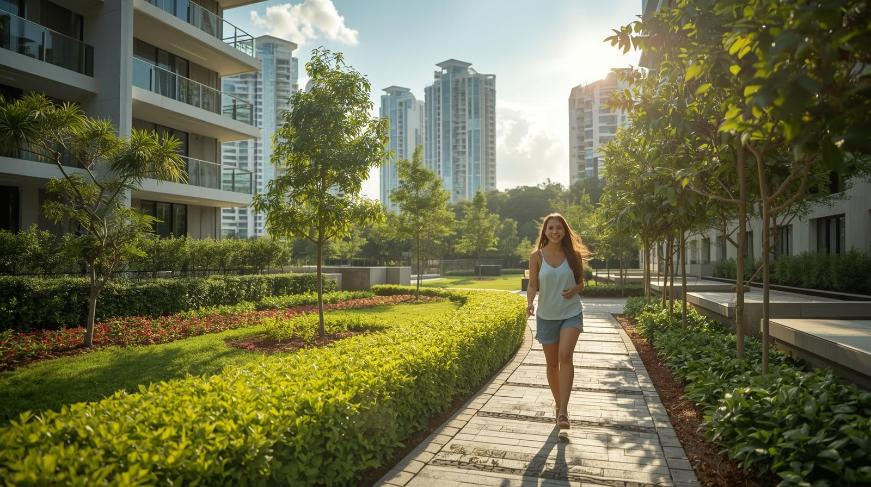
A Chuan Park balance unit in Singapore’s District 19 reaffirms Singapore’s ability to integrate economic growth and improved quality of life.
This 916-unit condominium along Lorong Chuan adds new modern residences to an existing mature neighborhood and strengthens the national goals of accessibility, connectivity, and community well-being. This development bridges the gaps in Singapore’s urban frameworks.
Strategic Location and Connectivity
Chuan Park’s Location is one of its most defining features. The Lorong Chuan MRT station on the Circle line is within walking distance of the new development.
This means Chuan Park residents can commute to all of Singapore’s economic, educational, and lifestyle opportunities. This level of connectivity improves the ability of residents to shift to new jobs and eliminates barriers to effective commuting.
These improvements increase productivity and make commuting more enjoyable.
The development also embodies Singapore’s commitment to transit-oriented development, which has had a more profound effect on Chuan Park.
When a community’s population density is concentrated near a centralized public transport hub and its surrounding core areas, planners avoid the encroachment of urban sprawl, in a sense, managing the growth of a community.
This particular strategy increases the economic productivity of an area by ensuring that more people can easily access jobs and services.
Community-Centric Living and Social Integration
Chuan Park is a positive example of how social sustainability is enhanced by the integration of a diverse range of local amenities, in addition to its transport connections.
Families can complete daily routines more easily due to their proximity to excellent schools, shops, and restaurants. Less travel for education and services strengthens families and enables greater active participation in communities.
The shared lifestyle spaces throughout the neighborhood enhance social interaction. Informal meeting places, such as cafes, shops, and recreational facilities, strengthen the ties of the community.
This multilayered environment is consistent with Singapore’s planning aim of self-sufficient precincts, where people can live, work, and socialize in close proximity.
ALSO READ: The Role of Exness Broker in Economic Stimulus and Recovery Efforts
Quality Residential Experience with Green Space
The positive impact of the design of the interiors of the development is also intentional. Internal communal spaces, active recreational facilities, and landscaped areas all encourage movement and mental rejuvenation.
Wellness amenities like fitness facilities, gardens, and swimming pools support residents’ healthier lifestyles and long-term well-being.
Singapore’s high urban density amplifies the importance of accessible greenery. The relaxation and restorative areas that are provided by greenery, which counterbalance the pressures of living in a high-density area, are more important than ever.
The quality of lifestyle that is offered by these features is also important for social integration, as shared greenery fosters informal social interaction, which is beneficial for developing relationships among residents.
Balancing Growth and Shared Prosperity
Chuan Park is a development that exemplifies the significant balance achieved in Singapore’s model of economic growth and social stability, particularly when housing is located near transit, community amenities are integrated, and the development is connected to an existing community network.
Chuan Park is a residential community that offers economic and social well-being.
These types of developments exemplify the level of liveability Singapore has achieved with growth. Singapore continues to replenish the cycle of growth and liveability through integrated transit, community design, and housing supply.